Praia Melão Sugar Mill: A Journey Through the Archaeological History of São Tomé and Príncipe
São Tomé and Príncipe is widely known for its tropical landscapes, volcanic mountains, beautiful beaches, cocoa plantations and lush rainforests. However, beyond its natural beauty lies another extraordinary dimension of the country: a rich history shaped by Portuguese colonisation, sugar production, plantation agriculture, Atlantic trade, African cultures and the lives of thousands of people who contributed to the development of the islands.
One of the most fascinating places to discover this history is the Praia Melão Sugar Mill, an archaeological site located on São Tomé Island, close to the coast and near the Manuel Jorge River.
The ruins of Praia Melão provide an exceptional opportunity to understand the early sugar plantation system of São Tomé and its connection with the wider Atlantic world. Archaeological research identifies Praia Melão as the largest known plantation and sugar mill on the island, active from the 16th to the 18th century. It is also the subject of the first archaeological project carried out in São Tomé and Príncipe.
Today, a visit to Praia Melão is much more than a sightseeing experience. It is a journey into the history of sugar, colonialism, technology, archaeology, African societies and the formation of the modern Atlantic world.
Where Is Praia Melão Sugar Mill?
The archaeological site of Praia Melão is located near the Manuel Jorge River, south of the fishing village of Praia Melão and approximately five kilometres south of São Tomé city.
Its location is particularly important because water played a central role in the operation of many historical sugar mills on the island.
Most of São Tomé’s early sugar mills were associated with rivers and streams descending from the central highlands towards the coast. Water could be channelled and used as a source of mechanical energy, making it possible to operate machinery for processing sugar cane.
This relationship between the river, landscape and mill is one of the most interesting aspects to explore during a historical tour.
Instead of seeing the ruins simply as an abandoned stone building, visitors can begin to understand them as part of a much larger agricultural and industrial landscape.
The Origins of Sugar Production in São Tomé
Sugar production became increasingly important in São Tomé after Portuguese colonisation.
During the 16th century, the island developed a plantation economy based largely on sugar cane. The production system required agricultural land, labour, water, transportation, processing facilities and access to international markets.
The sugar produced on São Tomé became connected to commercial networks extending across the Atlantic.
Historical research indicates the enormous scale of the sugar industry on the island. By 1595, there were reportedly around 95 sugar mills, and by 1600 the number had reached approximately 120. Some mills employed more than 200 enslaved workers.
Praia Melão developed within this wider sugar-producing landscape and eventually became one of the most important estates on the island.
Praia Melão: A Major Sugar Plantation
Praia Melão was not simply a small agricultural property.
Archaeological and historical research describes it as the largest plantation and sugar mill on São Tomé, operating from the 16th to the 18th century.
The estate combined agricultural production with industrial processing.
Sugar cane had to be cultivated, harvested and transported to the mill. Once there, the cane was processed to extract its juice, which could then be transformed into sugar through several stages.
The mill was therefore the industrial centre of the plantation.
The surrounding agricultural landscape supplied the raw material, while the mill provided the technology necessary to transform cane into a valuable commercial product.
This combination of agriculture, technology, labour and trade made places such as Praia Melão important elements in the development of the early Atlantic plantation system.
How Did the Sugar Mill Work?
One of the most remarkable features of Praia Melão is its hydraulic technology.
Archaeological investigations have identified remains associated with a water channel, or levada, positioned above the building. Evidence suggests that water was directed towards a vertical water wheel, which supplied mechanical power to the mill.
In simplified form, the system can be imagined as:
River → water channel → water wheel → mechanical power → sugar-processing machinery
This technology allowed the natural energy of flowing water to be transformed into mechanical energy.
For visitors interested in engineering and historical technology, Praia Melão offers an extraordinary opportunity to understand how people adapted the island’s natural environment to support industrial production centuries ago.
The river was not merely part of the landscape. It was an essential component of the production system.
The Architecture of Praia Melão
The surviving building is another important element of the archaeological site.
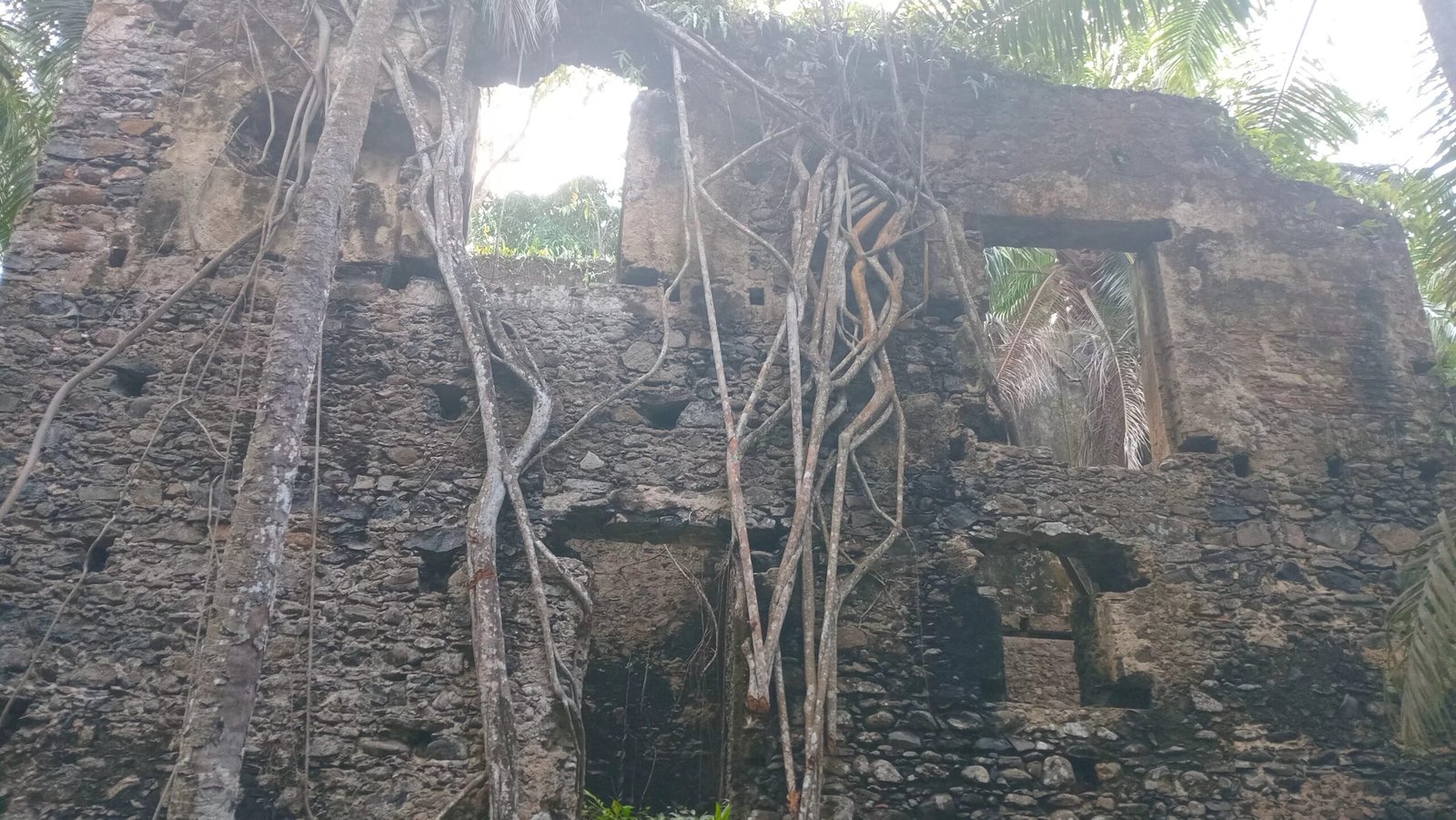
The structure was built in stone and developed over time through modifications and extensions. It has a rectangular layout and two floors, with internal stairs connecting the levels.
Archaeological research has found substantial quantities of roof-tile fragments, indicating that the building was roofed with tiles. Excavations carried out in 2023 recovered approximately 105 kilograms of roofing ceramics, mostly from the upper layers of the excavation.
The surviving walls are remarkably substantial, with many sections reaching several metres in preserved height.
However, the building is in a vulnerable condition. Parts of the walls and entrances have collapsed, and the original roof is no longer present.
This makes archaeological research and heritage conservation especially important.
The People Behind the Sugar
The history of Praia Melão cannot be understood solely through its architecture or technology.
The sugar economy of São Tomé was deeply connected to the enslavement of African people.
Enslaved people performed much of the agricultural and industrial labour required to maintain the plantation system. Archaeological research at Praia Melão therefore investigates not only sugar-production infrastructure but also structures and material evidence associated with the control of enslaved populations.
This part of the site’s history deserves particular attention.
A responsible historical tour should explain that the wealth generated by sugar production came within a system involving forced labour, violence and severe restrictions on human freedom.
Understanding this difficult history is essential to understanding São Tomé’s past.
Resistance and Social Change
The history of São Tomé’s sugar plantations also includes resistance.
During the late 16th and early 17th centuries, several sugar mills were affected by uprisings and revolts involving enslaved people. These conflicts contributed to the decline of São Tomé’s central role in the sugar economy.
The archaeological landscape therefore represents more than economic success.
It also contains evidence of a society marked by unequal power relationships, resistance and profound social transformation.
For modern visitors, this provides an opportunity to learn about the different communities and experiences that shaped São Tomé and Príncipe.
The Decline of the Sugar Industry
São Tomé’s sugar industry declined significantly during the 17th century.
Several factors contributed to this transformation, including competition from other Atlantic sugar-producing regions, economic changes and social conflicts.
However, Praia Melão did not simply disappear when sugar production declined.
The plantation adapted to changing circumstances and continued to be used for other activities. Research indicates that the estate later became associated with the production of sugar-cane spirit and cassava flour.
This transformation demonstrates how historical plantations could change their economic functions over time.
The ruins we see today are therefore the result of several periods of occupation and adaptation.
Archaeology at Praia Melão
One of the most important chapters in the recent history of Praia Melão began with archaeological research in the 21st century.
The project represents a major development in the study of São Tomé’s material history.
According to the research published in 2025, Praia Melão is the subject of the first archaeological project in São Tomé and Príncipe. Excavation campaigns, including work undertaken in 2022 and 2023, have provided new information about the structure of the mill and its relationship with sugar production and plantation society.
Archaeology is particularly valuable because written documents tell only part of the story.
Buildings, ceramics, water-management systems, architectural remains and other objects can provide evidence about how people actually lived and worked.
At Praia Melão, archaeology helps bring together these different sources of information.
Why Is Praia Melão Important?
Praia Melão is important not only because it is an old building.
Its significance extends far beyond the physical ruins.
The site helps researchers understand the development of plantation agriculture in Africa and the role of São Tomé in the emergence of the early modern Atlantic world.
The history of Praia Melão connects several themes:
Portugal → São Tomé → sugar → plantation agriculture → forced labour → Atlantic trade → African societies → the modern Atlantic world
This makes the site relevant not only to visitors interested in São Tomé’s history but also to travellers interested in African history, archaeology, colonial heritage and the history of global trade.
A Historical Tour to Praia Melão
A Praia Melão Sugar Mill Tour can be an excellent addition to a cultural itinerary in São Tomé.
The experience can begin in São Tomé city, travelling towards Praia Melão with a professional local guide.
During the journey, visitors can learn about the island’s colonisation, the introduction and development of sugar production, the plantation system and the importance of rivers to the old mills.
At Praia Melão, the guide can introduce the archaeological site and explain the surviving structures.
The tour can focus on:
– The history of Praia Melão;
– The development of sugar production;
– The architecture of the old mill;
– The hydraulic system;
– The Manuel Jorge River;
– The plantation landscape;
– Archaeological discoveries;
– The history of enslaved labour;
– Resistance and social change;
– The decline of the sugar economy;
– The importance of heritage preservation.
This approach transforms a simple visit into an educational cultural experience.
Who Should Visit Praia Melão?
Praia Melão is particularly interesting for travellers who want to experience a different side of São Tomé.
The site is ideal for people interested in:
– Archaeology;
– African history;
– Colonial history;
– Sugar production;
– Cultural tourism;
– Heritage tourism;
– Historical architecture;
– Plantation landscapes;
– Photography;
– Educational travel.
It can also be an interesting experience for students, researchers, historians, photographers and travellers who want to move beyond conventional beach tourism.
São Tomé has extraordinary natural attractions, but understanding its history makes the destination even richer.
Responsible Heritage Tourism
Because Praia Melão is an archaeological site, visitors should treat the location with care.
The ruins are vulnerable, and archaeological materials should never be removed from the site.
Visitors should avoid climbing unstable walls, moving stones, collecting ceramics or damaging surfaces.
They should also avoid writing on the walls or leaving any marks.
A responsible visitor understands that archaeological remains belong to the cultural heritage of the country and should be protected for future generations.
Tourism can contribute positively to this process by increasing awareness of the site’s importance and encouraging interest in preservation.
Discover São Tomé Beyond the Beaches
Many travellers arrive in São Tomé looking for tropical beaches, forests and adventure.
These experiences are an important part of the destination, but the island has another story waiting to be discovered.
The ruins of Praia Melão reveal a chapter of São Tomé’s history that connects the island to major transformations in the Atlantic world.
Here, the visitor can see how water, agriculture, architecture and technology were brought together to create an early sugar-processing system.
At the same time, the site encourages reflection on the human cost of that economic system and the experiences of the people who lived and worked within it.
This combination of history, archaeology and landscape makes Praia Melão a distinctive cultural destination.
Plan Your Praia Melão Historical Experience
A visit to the Praia Melão Sugar Mill is an opportunity to discover a lesser-known side of São Tomé and Príncipe.
Instead of simply passing through the landscape, visitors can learn how the island was transformed by sugar production and how São Tomé became connected to wider Atlantic networks.
With a local professional guide, the experience becomes much more meaningful. Historical information, archaeological evidence and local knowledge can be brought together to explain what happened at the site and why it remains important today.
For travellers looking for an authentic cultural experience, Praia Melão offers something different: a journey through the archaeological history of São Tomé and Príncipe.
Conclusion
The Praia Melão Sugar Mill is one of the most significant archaeological heritage sites associated with the history of sugar production in São Tomé and Príncipe.
Active from the 16th to the 18th century, it was once the island’s largest known plantation and sugar mill. Its surviving architecture, hydraulic infrastructure and archaeological remains provide valuable evidence about sugar production and plantation society.
But Praia Melão is also a place of human history.
Its story includes colonial expansion, African societies, forced labour, resistance, technological adaptation, economic transformation and the development of the Atlantic world.
The archaeological research carried out in recent years is helping to recover this history and protect a fragile heritage that might otherwise disappear.
Today, visiting Praia Melão offers travellers an opportunity to look beyond the postcard image of São Tomé and discover the deeper story of the island.
Explore Praia Melão, walk through its historic landscape and discover the archaeological heritage of São Tomé and Príncipe.
A journey to Praia Melão is not simply a visit to an old sugar mill.
It is a journey through centuries of history.
São Tomé and Príncipe is widely known for its tropical landscapes, volcanic mountains, beautiful beaches, cocoa plantations and lush rainforests. However, beyond its natural beauty lies another extraordinary dimension of the country: a rich history shaped by Portuguese colonisation, sugar production, plantation agriculture, Atlantic trade, African cultures and the lives of thousands of people who contributed to the development of the islands.
One of the most fascinating places to discover this history is the Praia Melão Sugar Mill, an archaeological site located on São Tomé Island, close to the coast and near the Manuel Jorge River.
The ruins of Praia Melão provide an exceptional opportunity to understand the early sugar plantation system of São Tomé and its connection with the wider Atlantic world. Archaeological research identifies Praia Melão as the largest known plantation and sugar mill on the island, active from the 16th to the 18th century. It is also the subject of the first archaeological project carried out in São Tomé and Príncipe.
Today, a visit to Praia Melão is much more than a sightseeing experience. It is a journey into the history of sugar, colonialism, technology, archaeology, African societies and the formation of the modern Atlantic world.
Where Is Praia Melão Sugar Mill?
The archaeological site of Praia Melão is located near the Manuel Jorge River, south of the fishing village of Praia Melão and approximately five kilometres south of São Tomé city.
Its location is particularly important because water played a central role in the operation of many historical sugar mills on the island.
Most of São Tomé’s early sugar mills were associated with rivers and streams descending from the central highlands towards the coast. Water could be channelled and used as a source of mechanical energy, making it possible to operate machinery for processing sugar cane.
This relationship between the river, landscape and mill is one of the most interesting aspects to explore during a historical tour.
Instead of seeing the ruins simply as an abandoned stone building, visitors can begin to understand them as part of a much larger agricultural and industrial landscape.
The Origins of Sugar Production in São Tomé
Sugar production became increasingly important in São Tomé after Portuguese colonisation.
During the 16th century, the island developed a plantation economy based largely on sugar cane. The production system required agricultural land, labour, water, transportation, processing facilities and access to international markets.
The sugar produced on São Tomé became connected to commercial networks extending across the Atlantic.
Historical research indicates the enormous scale of the sugar industry on the island. By 1595, there were reportedly around 95 sugar mills, and by 1600 the number had reached approximately 120. Some mills employed more than 200 enslaved workers.
Praia Melão developed within this wider sugar-producing landscape and eventually became one of the most important estates on the island.
Praia Melão: A Major Sugar Plantation
Praia Melão was not simply a small agricultural property.
Archaeological and historical research describes it as the largest plantation and sugar mill on São Tomé, operating from the 16th to the 18th century.
The estate combined agricultural production with industrial processing.
Sugar cane had to be cultivated, harvested and transported to the mill. Once there, the cane was processed to extract its juice, which could then be transformed into sugar through several stages.
The mill was therefore the industrial centre of the plantation.
The surrounding agricultural landscape supplied the raw material, while the mill provided the technology necessary to transform cane into a valuable commercial product.
This combination of agriculture, technology, labour and trade made places such as Praia Melão important elements in the development of the early Atlantic plantation system.
How Did the Sugar Mill Work?
One of the most remarkable features of Praia Melão is its hydraulic technology.
Archaeological investigations have identified remains associated with a water channel, or levada, positioned above the building. Evidence suggests that water was directed towards a vertical water wheel, which supplied mechanical power to the mill.
In simplified form, the system can be imagined as:
River → water channel → water wheel → mechanical power → sugar-processing machinery
This technology allowed the natural energy of flowing water to be transformed into mechanical energy.
For visitors interested in engineering and historical technology, Praia Melão offers an extraordinary opportunity to understand how people adapted the island’s natural environment to support industrial production centuries ago.
The river was not merely part of the landscape. It was an essential component of the production system.
The Architecture of Praia Melão
The surviving building is another important element of the archaeological site.
The structure was built in stone and developed over time through modifications and extensions. It has a rectangular layout and two floors, with internal stairs connecting the levels.
Archaeological research has found substantial quantities of roof-tile fragments, indicating that the building was roofed with tiles. Excavations carried out in 2023 recovered approximately 105 kilograms of roofing ceramics, mostly from the upper layers of the excavation.
The surviving walls are remarkably substantial, with many sections reaching several metres in preserved height.
However, the building is in a vulnerable condition. Parts of the walls and entrances have collapsed, and the original roof is no longer present.
This makes archaeological research and heritage conservation especially important.
The People Behind the Sugar
The history of Praia Melão cannot be understood solely through its architecture or technology.
The sugar economy of São Tomé was deeply connected to the enslavement of African people.
Enslaved people performed much of the agricultural and industrial labour required to maintain the plantation system. Archaeological research at Praia Melão therefore investigates not only sugar-production infrastructure but also structures and material evidence associated with the control of enslaved populations.
This part of the site’s history deserves particular attention.
A responsible historical tour should explain that the wealth generated by sugar production came within a system involving forced labour, violence and severe restrictions on human freedom.
Understanding this difficult history is essential to understanding São Tomé’s past.
Resistance and Social Change
The history of São Tomé’s sugar plantations also includes resistance.
During the late 16th and early 17th centuries, several sugar mills were affected by uprisings and revolts involving enslaved people. These conflicts contributed to the decline of São Tomé’s central role in the sugar economy.
The archaeological landscape therefore represents more than economic success.
It also contains evidence of a society marked by unequal power relationships, resistance and profound social transformation.
For modern visitors, this provides an opportunity to learn about the different communities and experiences that shaped São Tomé and Príncipe.
The Decline of the Sugar Industry
São Tomé’s sugar industry declined significantly during the 17th century.
Several factors contributed to this transformation, including competition from other Atlantic sugar-producing regions, economic changes and social conflicts.
However, Praia Melão did not simply disappear when sugar production declined.
The plantation adapted to changing circumstances and continued to be used for other activities. Research indicates that the estate later became associated with the production of sugar-cane spirit and cassava flour.
This transformation demonstrates how historical plantations could change their economic functions over time.
The ruins we see today are therefore the result of several periods of occupation and adaptation.
Archaeology at Praia Melão
One of the most important chapters in the recent history of Praia Melão began with archaeological research in the 21st century.
The project represents a major development in the study of São Tomé’s material history.
According to the research published in 2025, Praia Melão is the subject of the first archaeological project in São Tomé and Príncipe. Excavation campaigns, including work undertaken in 2022 and 2023, have provided new information about the structure of the mill and its relationship with sugar production and plantation society.
Archaeology is particularly valuable because written documents tell only part of the story.
Buildings, ceramics, water-management systems, architectural remains and other objects can provide evidence about how people actually lived and worked.
At Praia Melão, archaeology helps bring together these different sources of information.
Why Is Praia Melão Important?
Praia Melão is important not only because it is an old building.
Its significance extends far beyond the physical ruins.
The site helps researchers understand the development of plantation agriculture in Africa and the role of São Tomé in the emergence of the early modern Atlantic world.
The history of Praia Melão connects several themes:
Portugal → São Tomé → sugar → plantation agriculture → forced labour → Atlantic trade → African societies → the modern Atlantic world
This makes the site relevant not only to visitors interested in São Tomé’s history but also to travellers interested in African history, archaeology, colonial heritage and the history of global trade.
A Historical Tour to Praia Melão
A Praia Melão Sugar Mill Tour can be an excellent addition to a cultural itinerary in São Tomé.
The experience can begin in São Tomé city, travelling towards Praia Melão with a professional local guide.
During the journey, visitors can learn about the island’s colonisation, the introduction and development of sugar production, the plantation system and the importance of rivers to the old mills.
At Praia Melão, the guide can introduce the archaeological site and explain the surviving structures.
The tour can focus on:
– The history of Praia Melão;
– The development of sugar production;
– The architecture of the old mill;
– The hydraulic system;
– The Manuel Jorge River;
– The plantation landscape;
– Archaeological discoveries;
– The history of enslaved labour;
– Resistance and social change;
– The decline of the sugar economy;
– The importance of heritage preservation.
This approach transforms a simple visit into an educational cultural experience.
Who Should Visit Praia Melão?
Praia Melão is particularly interesting for travellers who want to experience a different side of São Tomé.
The site is ideal for people interested in:
– Archaeology;
– African history;
– Colonial history;
– Sugar production;
– Cultural tourism;
– Heritage tourism;
– Historical architecture;
– Plantation landscapes;
– Photography;
– Educational travel.
It can also be an interesting experience for students, researchers, historians, photographers and travellers who want to move beyond conventional beach tourism.
São Tomé has extraordinary natural attractions, but understanding its history makes the destination even richer.
Responsible Heritage Tourism
Because Praia Melão is an archaeological site, visitors should treat the location with care.
The ruins are vulnerable, and archaeological materials should never be removed from the site.
Visitors should avoid climbing unstable walls, moving stones, collecting ceramics or damaging surfaces.
They should also avoid writing on the walls or leaving any marks.
A responsible visitor understands that archaeological remains belong to the cultural heritage of the country and should be protected for future generations.
Tourism can contribute positively to this process by increasing awareness of the site’s importance and encouraging interest in preservation.
Discover São Tomé Beyond the Beaches
Many travellers arrive in São Tomé looking for tropical beaches, forests and adventure.
These experiences are an important part of the destination, but the island has another story waiting to be discovered.
The ruins of Praia Melão reveal a chapter of São Tomé’s history that connects the island to major transformations in the Atlantic world.
Here, the visitor can see how water, agriculture, architecture and technology were brought together to create an early sugar-processing system.
At the same time, the site encourages reflection on the human cost of that economic system and the experiences of the people who lived and worked within it.
This combination of history, archaeology and landscape makes Praia Melão a distinctive cultural destination.
Plan Your Praia Melão Historical Experience
A visit to the Praia Melão Sugar Mill is an opportunity to discover a lesser-known side of São Tomé and Príncipe.
Instead of simply passing through the landscape, visitors can learn how the island was transformed by sugar production and how São Tomé became connected to wider Atlantic networks.
With a local professional guide, the experience becomes much more meaningful. Historical information, archaeological evidence and local knowledge can be brought together to explain what happened at the site and why it remains important today.
For travellers looking for an authentic cultural experience, Praia Melão offers something different: a journey through the archaeological history of São Tomé and Príncipe.
Conclusion
The Praia Melão Sugar Mill is one of the most significant archaeological heritage sites associated with the history of sugar production in São Tomé and Príncipe.
Active from the 16th to the 18th century, it was once the island’s largest known plantation and sugar mill. Its surviving architecture, hydraulic infrastructure and archaeological remains provide valuable evidence about sugar production and plantation society.
But Praia Melão is also a place of human history.
Its story includes colonial expansion, African societies, forced labour, resistance, technological adaptation, economic transformation and the development of the Atlantic world.
The archaeological research carried out in recent years is helping to recover this history and protect a fragile heritage that might otherwise disappear.
Today, visiting Praia Melão offers travellers an opportunity to look beyond the postcard image of São Tomé and discover the deeper story of the island.
Explore Praia Melão, walk through its historic landscape and discover the archaeological heritage of São Tomé and Príncipe.
A journey to Praia Melão is not simply a visit to an old sugar mill.
It is a journey through centuries of history.
